India's Battery PLI Scheme Misses Capacity Target, Faces Structural Hurdles
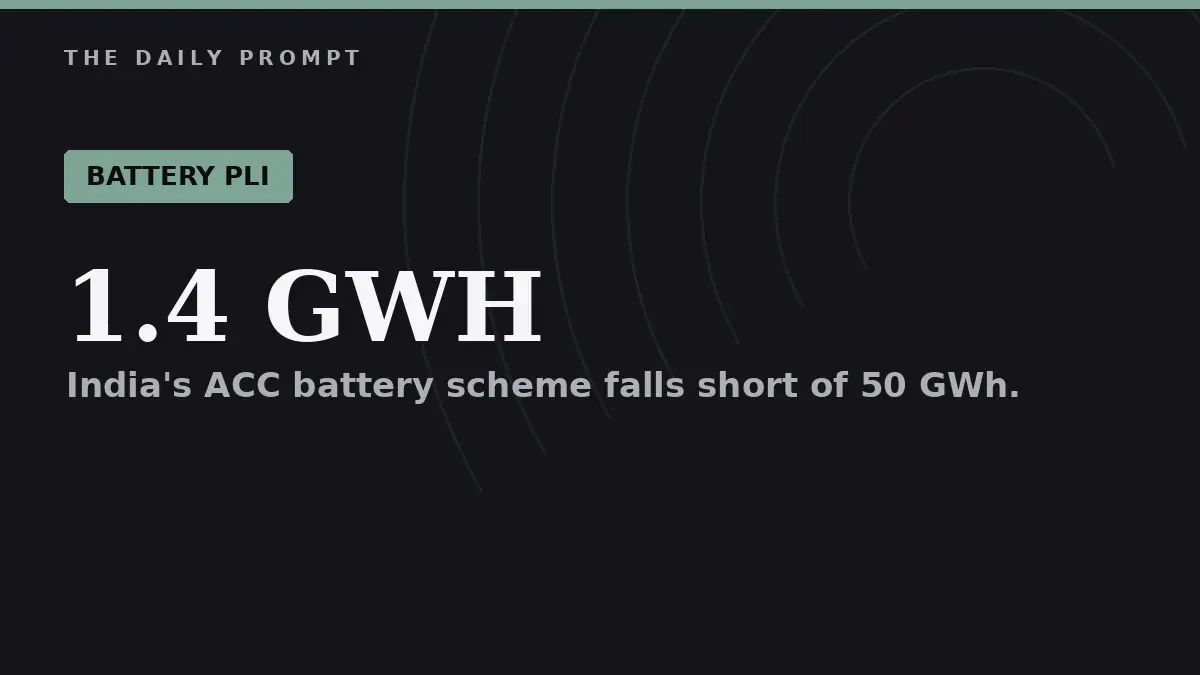
India's Production Linked Incentive (PLI) scheme for Advanced Chemistry Cell (ACC) batteries has significantly fallen short of its initial target, according to a recent report from NITI Aayog. The scheme, which aimed to develop 50 gigawatt-hours (GWh) of manufacturing capacity, has so far only developed 1.4 GWh, with commercial production yet to commence. The NITI Aayog report, titled "Impact Assessment of PLI Schemes" and prepared in collaboration with IIM Ahmedabad, attributes this slower-than-expected progress to a combination of technological limitations, a reliance on imports, and delays in establishing manufacturing facilities.
The Rs 18,100 crore scheme is designed to bolster domestic manufacturing capacity for advanced batteries, essential for electric vehicles and energy storage systems, thereby reducing India's dependence on imported battery technologies. As of March 2026, cumulative investment under the scheme reached Rs 4,570 crore, generating 1,245 jobs. However, no incentive disbursements have been reported because commercial production has not yet begun, as stated in the report.
Key challenges highlighted by the assessment include India's limited domestic capabilities in advanced battery manufacturing, which perpetuates a dependence on foreign technology and expertise. Furthermore, the absence of a developed domestic supply chain for critical battery components, such as cathodes, anodes, and essential minerals like lithium and cobalt, makes it difficult for manufacturers to meet the scheme's localisation requirements. These requirements stipulate at least 25 percent domestic value addition by the end of the second year and 60 percent by the fifth year, which the report observes appear challenging to achieve given current manufacturing capabilities.
The report also notes that weak execution is reflected in the limited capacity addition and the lack of incentive disbursement. Slower-than-expected growth in electric vehicle demand has further dampened investment pace. These factors suggest that the scheme's lag is not merely cyclical but rooted in deeper structural constraints. The assessment also revealed that one beneficiary company was disqualified due to the suppression of material facts. Despite these hurdles, the report maintains a positive longer-term outlook, emphasizing that investments in advanced battery technologies require substantial time to translate into production, and actual impact will only be felt over time.
What to watch: Commencement of commercial production and future incentive disbursements.
Editor's note: The draft effectively summarizes the NITI Aayog report, covering the capacity gaps, financial data, and structural challenges.
AI-generated and fact-checked against the original report; claims the gate cannot verify are held back.